 en
en  CN
CN ES
ES PT
PT SV
SV DE
DE TR
TR FR
FR PL
PL RO
RO RU
RU IW
IW ID
ID LV
LV LT
LT SR
SR SK
SK SL
SL UK
UK VI
VI SQ
SQ ET
ET GL
GL HU
HU MT
MT
What is an intraoral scanner?
An intraoral scanner is a dental device that is used to capture detailed, three-dimensional images of the inside of a patient's mouth. It is a valuable tool in dentistry for creating digital impressions of the teeth and oral structures. The scanner typically consists of a handheld wand or probe with a small camera at its tip, and it is designed to be maneuvered within the oral cavity to capture images from various angles.
Benefits of digital dental intraoral scanners
·Precision and Accuracy: Intraoral scanners provide highly accurate digital impressions, reducing the chances of errors associated with traditional impressions.
·Comfort for Patients: Many patients find intraoral scanning more comfortable than traditional impressions, as it eliminates the need for impression materials that can be messy and cause discomfort.
·Time Efficiency: Digital scanning is often faster than traditional impression-taking methods, saving time for both dental professionals and patients.
·Digital Records: The digital impressions can be stored electronically, making it easier to manage patient records, share information with other dental professionals, and track changes in the patient's oral health over time.
·Improved Communication: The digital models can be easily shared with dental laboratories, specialists, or other healthcare providers, facilitating collaboration and communication.
How an intraoral scanner generally works:
·Image Capture: The handheld wand is moved around the patient's mouth, and the built-in camera rapidly captures multiple images of the teeth and surrounding tissues.
·Real-time Imaging: The scanner provides real-time feedback on a computer screen, allowing the dental professional to visualize the captured images instantly. This helps ensure that all necessary areas are adequately scanned.
·Software Processing: The captured images are processed by specialized software to create a highly accurate digital model of the patient's oral anatomy.
·Digital Impressions: The digital model serves as a virtual impression of the patient's teeth, eliminating the need for traditional physical impressions made with materials like dental putty.
Are intraoral scanners easy to use?
Intraoral scanners are designed to be user-friendly, and their ease of use can vary based on factors such as the specific scanner model, the software interface, and the user's familiarity with the technology. Overall, however, manufacturers strive to make intraoral scanners intuitive and efficient for dental professionals.
Here are some factors that contribute to the ease of use:
Ergonomic Design: Intraoral scanners are often designed with ergonomic considerations to ensure comfort for both the dental professional and the patient during the scanning process. The handheld wand is typically lightweight and easy to maneuver.
Real-time Feedback: Many intraoral scanners provide real-time imaging feedback on a connected computer screen. This allows the operator to visualize the scanned areas as they work, making it easier to ensure comprehensive coverage.
User-friendly Software: The accompanying software plays a crucial role in the ease of use. Intuitive software interfaces make it simpler for dental professionals to navigate through the scanning process, review images, and make any necessary adjustments.
Training and Support: Dental professionals often receive training from the scanner's manufacturer or distributor. Training sessions help users become familiar with the device, its features, and the scanning techniques. Ongoing support is also typically available to address any questions or issues that may arise.
Updates and Improvements: Manufacturers may release software updates to improve functionality, address user feedback, and introduce new features. Regular updates can enhance the overall user experience.
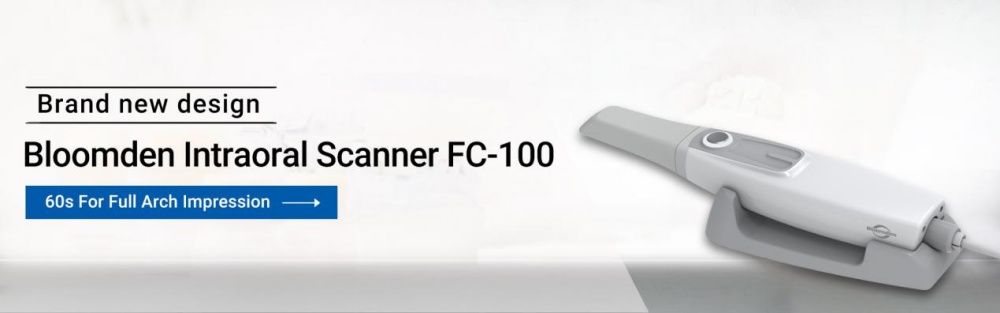
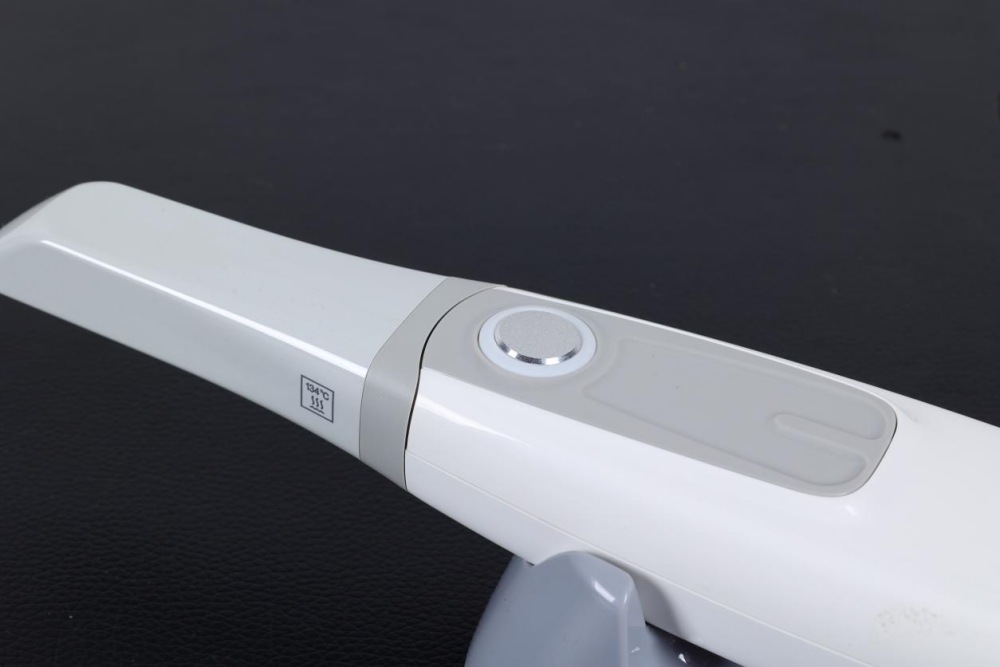
Instruction of Bloomden Intraoral scanner FC-100
Bloomden Intraoral scanner FC-100 is a dental 3D scanner intended to be used to digitally record topographical characteristics of teeth and surrounding tissues. The system produces 3D scans for use in computerassisted design and manufacturing of dental restorations. It has new design, light weight and small size, which can reduce diagnosis time for doctors and bring comfortable experience to patients.
Benefits of Bloomden Intraoral scanner FC-100
· AI intelligent scanning
· Fashionable & Lightweight
· Powerful circuit cooling system
· Clear margin line, high accuracy
· Fast scanning speed, easy to learn and use
· 2 Different tips, meet more demands of different applications
Specification
Cmos |
13 x 13mm |
Pixel Size |
1024 X 768 pixels |
Scope of reconstruction |
14 x 14 x 15 mm |
Intensity of light radiation |
|
Size of Scanner(scanning tip excluded) |
200mm(L)*58mm(W)*36mm(H) |
Size of Scanning Tip |
79mm(L)*19. 7mm(W)*15. 8mm(H) |
Size of Mini Tip |
80mm(L)*16mm(W)*11mm(H) |
Data cable of scanner (connection between base and handpiece) |
1. 9m |
Phase Acquisition Technology |
Optical continuous video capture |
Usb data cable (base and computer connection) |
1. 2m |
Usb Connection |
USB2. 0 |
Scan Depth |
0-15mm |
Scanning Accuracy |
Single crown≤15μm≤30μm |
Quick Reset |
yes |
Model Optimization |
yes |
Output Files |
STL, PLY, OBJ |
Net Weight |
225g |
Scanner Tip |
3 standard scanner tips, 1 protective tip |
Small Scanner Tip |
Optional |
Size(standard scanner tips) |
79 x 19. 7x 15. 8mm |
Size(mini scanner tips) |
80 x 16x 11mm |
Scan Tip Anti-fogging Method |
Adopts self-heating scan tip |
Calibration Tip |
1 set (optional) |
Scanning Accuracy |
15μm for single crown and 30μm for full arch |
Operating Temperature |
10℃-40℃ |
Operating Humidity |
≤85% |
Storage Temperature |
-10℃-55℃ |
Storage Humidity |
≤93% |
Atomospheric Pressure |
86KPa~106KPa |
Input |
100-240V~50-60HZ,0. 7A |
Output |
12V1. 5A |
Intraoral Scanner |
12V1. 5A |
Bloomden Bioceramics(Hunan) Co., Ltd. (hereinafter referred to as Bloomden) is located in Changsha, Hunan.